We frequently receive inquiries regarding TEM observation of ferromagnetic materials. Many institutions decline to accept ferromagnetic samples for observation as a matter of policy, out of concern for instrument protection. This is a reasonable and defensible position from the standpoint of protecting the equipment.
At the same time, some researchers genuinely need to observe ferromagnetic samples for their work, yet cannot obtain support elsewhere, and consult the Division of Analytical Electron Microscopy, IMR as a result. We have a track record of accommodating samples brought to us under these circumstances.
Provided that appropriate precautions and preparation are in place, we consider ferromagnetic material observation to be feasible. The risk of instrument damage cannot be eliminated entirely, but some experiments must be carried out regardless. As a shared facility, we believe our role is not to refuse such requests outright on the grounds of risk, but to build a framework that allows us to respond once the risk is properly understood.
This does not mean unconditional acceptance, however. Users must fully understand the following information and complete the required preparation and disclosure beforehand.
1. Potential Problems
The objective lens of a TEM generates a strong magnetic field of roughly 2 T at the sample position. A ferromagnetic sample becomes magnetized within this field, which can lead to the following problems.
- The sample moves, tilts, or deforms under magnetic force
- A sample that is not firmly mounted detaches from the holder
- Magnetic force pulls the sample so that the holder’s Y-tilt drifts away from the set value
- Brittle samples can be damaged by the magnetic force itself, or by the impact of detachment
- A detached sample can be magnetically drawn to and collide with the objective lens or other components, remaining attached
- Magnetic material lodged there disturbs the objective lens field distribution, degrading performance (e.g., resolution)
- Adjusting focus (changing the excitation current) also changes the magnetic force on the sample, which can cause further movement
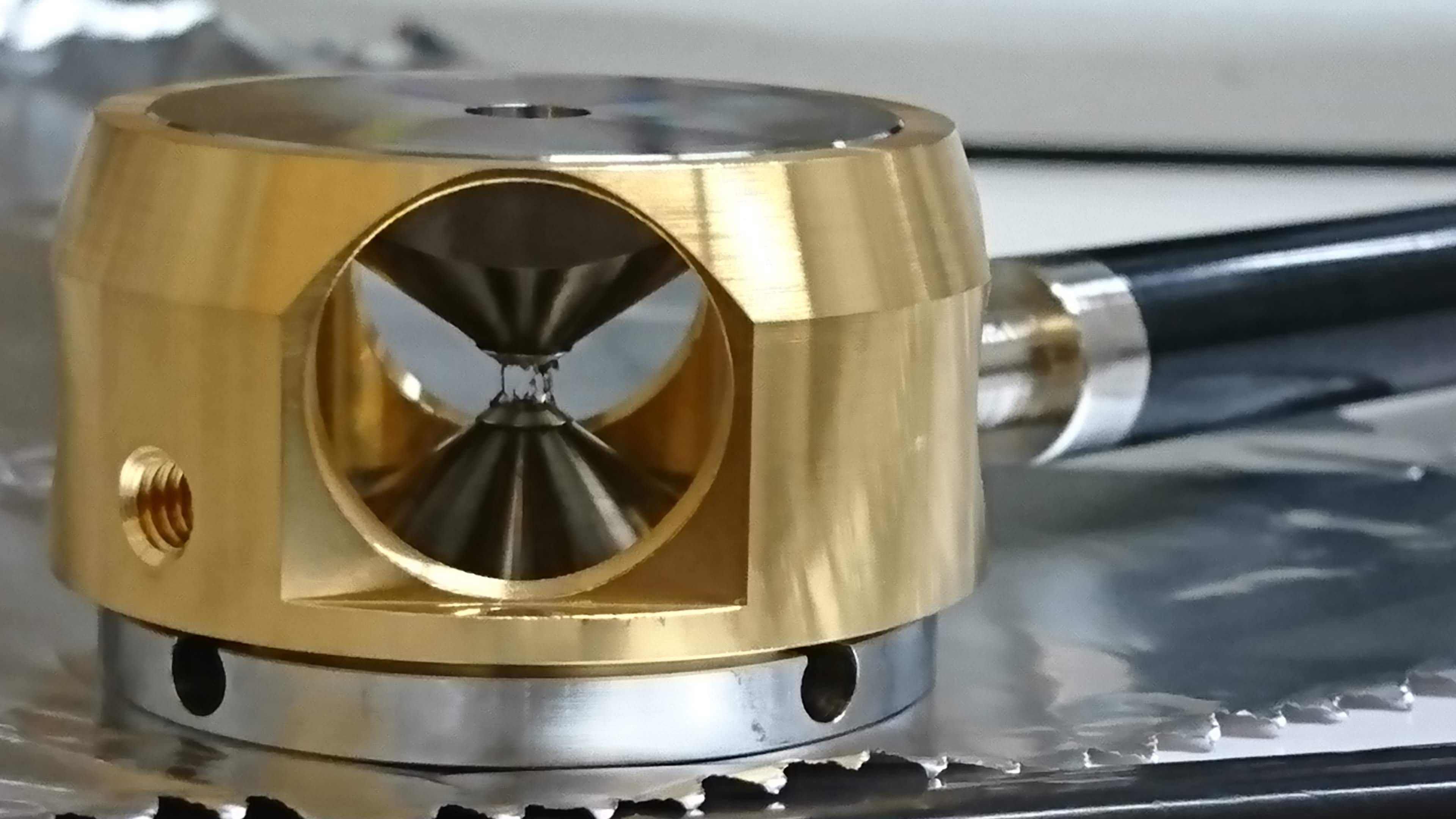
The photograph below shows an actual case in which a detached sample became magnetically lodged on the pole piece. The sample was shattered by the impact of the collision.
2. Underlying Cause
The underlying cause is magnetization of the sample by the strong objective lens field. Since the degree of magnetization is roughly proportional to sample volume, the magnitude of the effect is largely determined by how much sample volume is introduced.
3. Measures to Reduce the Effect
(1) Reduce sample volume
Even for the same material, the effective volume and degree of impact vary considerably depending on the preparation method.
| Preparation method | Volume | Magnetic effect |
|---|---|---|
| Electropolishing | Large | Susceptible to effects (particular caution needed for highly magnetic materials) |
| Ion milling / ion slicing | Large to medium | Similar caution required |
| FIB | Very small | Effect is essentially negligible |
| Nanoparticles / ferromagnetic layers within layered devices | Very small | Effect is essentially absent |
If safety is the priority, FIB preparation is recommended. If bulk samples are essential for the research, they will be considered on a case-by-case basis (see the EM-002B initial screening procedure below).
Melt-spun ribbons and similar samples, which are easy to prepare and are often observed as-is, also require caution when brittle, since the risk of damage or detachment from magnetic force increases accordingly.
For crushed/powder samples containing relatively large residual particles, the particles themselves can move under the objective lens field. For samples with a certain degree of magnetization, embedding in resin followed by thinning is effective for suppressing this effective mobility.
As a rough guideline for bulk samples, for example with bulk Fe, thinning to a maximum thickness of around 20 μm is advisable. Even after thinning, however, insufficient mounting on the holder still leaves a risk of detachment, falling, and adhesion inside the column.
(2) Screening before insertion
With the sample mounted on the holder, bring a neodymium magnet close to it before TEM insertion and check its behavior. If it is readily attracted to the magnet, a stronger effect can be expected inside the TEM (2 T).
(3) Operation during insertion
The larger the sample movement within the magnetic field, the stronger the magnetic force exerted on it. Inserting the holder in LOWMAG mode (objective lens OFF) reduces this effect.
4. Undetected Detachment: A Cautionary Case
Sample detachment is not always obvious.
In one documented case, a user who found no sample mounted at the start of TEM observation assumed they had forgotten to attach it, and continued the experiment after mounting a new sample. In fact, the original sample had already detached due to magnetic force at the time of the first insertion.
Because of this misunderstanding, the detachment was never reported and the experiment continued. It was only discovered later, during separate maintenance work, that a large sample fragment had become lodged on the pole piece — and that this was the cause of previously unexplained instability in lens performance.
If a mounted sample cannot be confirmed during observation of a magnetic sample, consider magnetic detachment — not a forgotten mounting step — as the primary possibility, and always report it rather than resolving it on your own.
5. Runaway Y-Tilt and Risk of Instrument Damage
Because a ferromagnetic sample tends to align its long axis with the magnetic field direction, the Y-tilt can increase unintentionally. When this happens, the tilt angle shown on the TEM display no longer matches the actual tilt angle.
When the holder is withdrawn, the displayed stage position resets to 0°, but the stage may remain physically tilted internally.
- On TEMs with a large pole piece gap: after the holder is withdrawn, the sample can remain in a tilted state even though the display still reads 0°.
- On high-resolution TEMs with a small gap: during withdrawal, the stage contacts the objective lens, and this contact forcibly resets the tilt. Because this occurs during the withdrawal motion itself, the user has no way of noticing it.
This contact can damage the objective lens itself, dislodge the pole piece cap, or deform the objective aperture inserted within the gap through contact.
The system is designed to stop motion via a hard limit switch upon physical contact between the holder and the column, but detection is not always fast enough. This is because the underlying situation — the sample stage being displaced to an unexpected position due to the magnetic field — is not something the instrument’s design anticipates. In addition, because the Y-axis is forced by the magnetic field to a tilt angle it would not normally reach, the tilt mechanism itself can sometimes bind.
6. Our Division’s Policy
A significant number of institutions decline, as a matter of policy, to accept ferromagnetic samples for observation. This is an understandable position from the standpoint of protecting equipment, but our Division takes the position that we will respond “given appropriate preparation.” We therefore do not prohibit ferromagnetic sample observation, but we require the following as mandatory conditions.
- Prior disclosure, discussion, and preparation are always required.
- If observation is carried out without this, and damage results, we will charge the full cost of repair.
Even a simple case of sample detachment can require raising the column to access the interior of the objective lens, followed by realignment, potentially resulting in a cost of roughly 2 million yen and downtime of a month or more, including securing a manufacturer’s engineer.
For bulk ferromagnetic samples (prepared by electropolishing, ion milling, ion slicing, etc.) observed at our Division, the following procedure applies.
- The initial observation must always be performed on the EM-002B. Because the EM-002B’s pole piece is replaceable, it can be accessed without raising the column, allowing comparatively low-cost, short-duration recovery in the event of an accident.
- Only samples confirmed to observe without problems on the EM-002B will be approved for use on other TEMs.
Note, however, that the EM-002B itself cannot be used without limit. Being an aging instrument, frequent venting of the column (breaking vacuum) shortens its service life. Manufacturer support has also already ended, so any failure requires in-house repair by staff. Screening on the EM-002B should therefore also be planned carefully rather than performed casually.
Summary
In TEM observation of ferromagnetic materials, magnetization caused by the objective lens field can be the source of a wide range of problems, from sample damage and detachment to damage to the instrument itself. The key points are as follows.
- Reduce sample volume wherever possible, for example through FIB preparation
- Screen the sample with a neodymium magnet before insertion
- Insert the holder in LOWMAG mode
- If a mounted sample cannot be confirmed, suspect magnetic detachment rather than a forgotten mounting step
- For bulk ferromagnetic samples, prior disclosure is mandatory, followed by initial screening on the EM-002B
For questions or advance consultation, please contact the Division of Analytical Electron Microscopy, IMR.